Tag: installation

  • shasti

    shasti

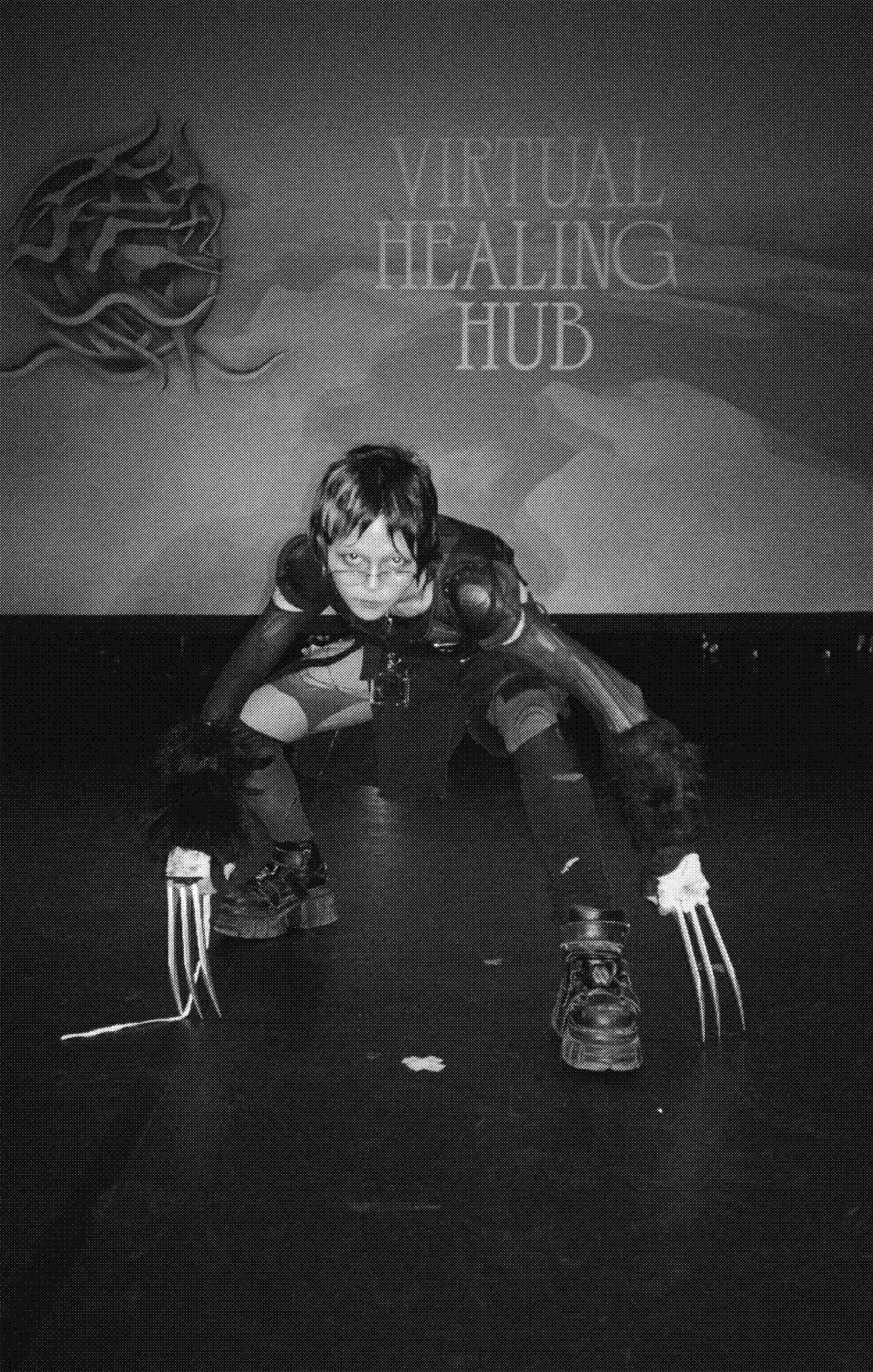
    shasti (they/them/dia) is an artist, organizer, and DJ born in Jakarta who lives between Berlin and Bochum. Shasti’s work in the field of digital art encompasses performance, live audiovisual sets, and multimedia productions such as sound and mixed realities. Shasti’s works create a form of hauntology in which the relationship between magic, technology, the body, and community represents a political re-enchantment. In collaboration with 3D artist songxin, they created a world shaped by memories and the revolutionary vision of ghost stories. Dia’s work “Phantom Power” combines digital voice modification with the performative embodiment of the monstrous and has been featured in several productions, including “Virtual Healing Hub” by dgtl fmnsm and “Unreal Conditionals” by Janne Kummer and g.h0st.damXg. Shasti currently works at the Kunstmuseum Bochum as a staff member for digital and hybrid art education.

    An audiovisual set that combines DJing and VJing. The DJ set itself is geared more toward storytelling. I explore the themes of dreams, fantasy, and isekai—the idea of being transported into a game world. Rather than portraying this as an escape from reality, I offer a perspective of re-enchantment.

  • Olaf Val

    Olaf Val

    Olaf Val (born in Hanau in 1968) studied art in Kassel and completed his graduate studies at the Academy of Media Arts in Cologne. He has exhibited regularly since 1996—including internationally until 2014—and has worked as a freelance artist since 2003 and taught as a lecturer since 2004. From 2012 to 2022, he was an active board member of the Kassel Art Association, for which he curated solo and group exhibitions, among other activities. Since then, his artistic focus has shifted toward ecological issues, which he increasingly explores through the medium of sound art—with the aim of making a poetic appreciation of the environment tangible through sound.

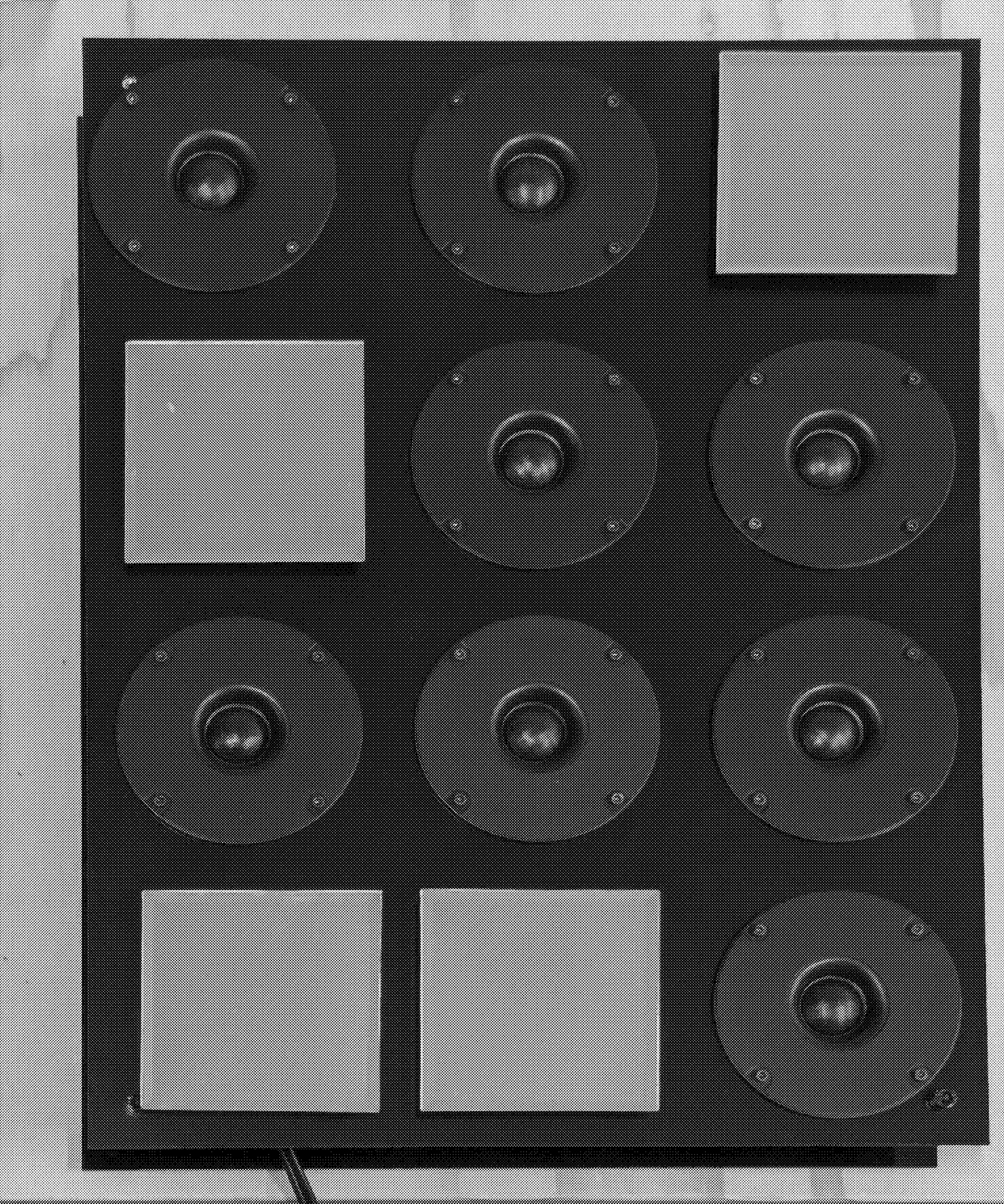
    THRESH()LD At a time when social and ecological systems are under increasing pressure, the multichannel sound object THRESH()LD develops an acoustic language for experiencing structural fragility. The installation explores those critical thresholds where materials, bodies, and social structures are on the verge of collapse—a state that can be described as a “global risk society.” Unlike many large-scale sound installations, THRESH()LD concentrates its energy within a compact, sculptural form. The work unfolds not through expansion but through condensation: its small size deliberately invites the viewer to approach it. Only those who approach it experience the subtle vibrations, reflections, and sonic processes. Thus, the sculpture functions less like a speaker system and more like an artistic-technical entity in which physical processes and subjective perception converge. THRESH()LD transforms contemplative art appreciation into a collective test of endurance. The dissonant sound frequencies challenge visitors’ physical and psychological tolerance thresholds and make their own thresholds immediately palpable. In this way, THRESH()LD positions itself as a critical intervention in a time of multiple crises: it makes audible and tangible what often remains abstract. The installation thus becomes an instrument that registers the shifts in our present and transforms them into an intense sensory experience in action. 12-channel audio object Plugdata sketch with a generative composition 1 Raspberry Pi 5 2 ESI Gigaport eX audio interfaces 6 ZHITING 200W TPA3116 amplifiers 8 VISATON SC 10N tweeters 4 LAVOCE bass drivers with attached mirrors

  • Anja Kellner and Hakon Hennig

    Anja Kellner and Hakon Hennig

    Anja Kellner is a multifaceted artist whose interactive installations, kinetic works, and media art reflect on sociopolitical themes such as sustainability, gender equality, and the impact of the digital revolution on everyday life. The “Deja-Vú Tabula Rasa” series of works illustrates her ability to combine artistic visions with technological and social innovations. In installations such as “Auge um Auge” or “Forced Swing,” she uses sound to convey fragments of memory and resonant catastrophes. In developing “LiSe—the light sensor,” which opens up new possibilities for accessibility for the blind, she demonstrates her creative and technical expertise. With artistic sensitivity, she addresses environmental issues in the design of alternative “dye-sensitized solar cells.” Her artistic research feeds into projects such as “Power Plant,” a multimedia installation that generates CO₂-negative energy via microbial fuel cells. The perpetual motion machine serves as a positive, utopian narrative for overcoming the climate crisis. Her experience informs a visiting lectureship during the 2024–25 winter semester on the topics of the “Internet of Things” and “Sound Worlds” at the Kassel Art Academy. Likewise, her long-standing work with Hakon Hennig—an electronics developer and artist with a background in electrical engineering and photography—has complemented this perspective with his technical expertise. His contribution an Tarek Atoui’s project “Metastable Circuit 1” (documenta 13), as well as art installations such as “Gespräch unter vier Augen,” “Erraquisition,” and “ComfortClock,” demonstrate his ability to integrate technical systems into artistic contexts. Transparency and the revelation of technical components and circuitry characterize his artistic practice. Through the development of a vacuum chamber for electron diffraction and the design of an innovative circuit for his Polarskop, Hakon impressively demonstrates his profound and comprehensive understanding of complex systems. This complexity becomes aesthetically tangible in his kinetic works.

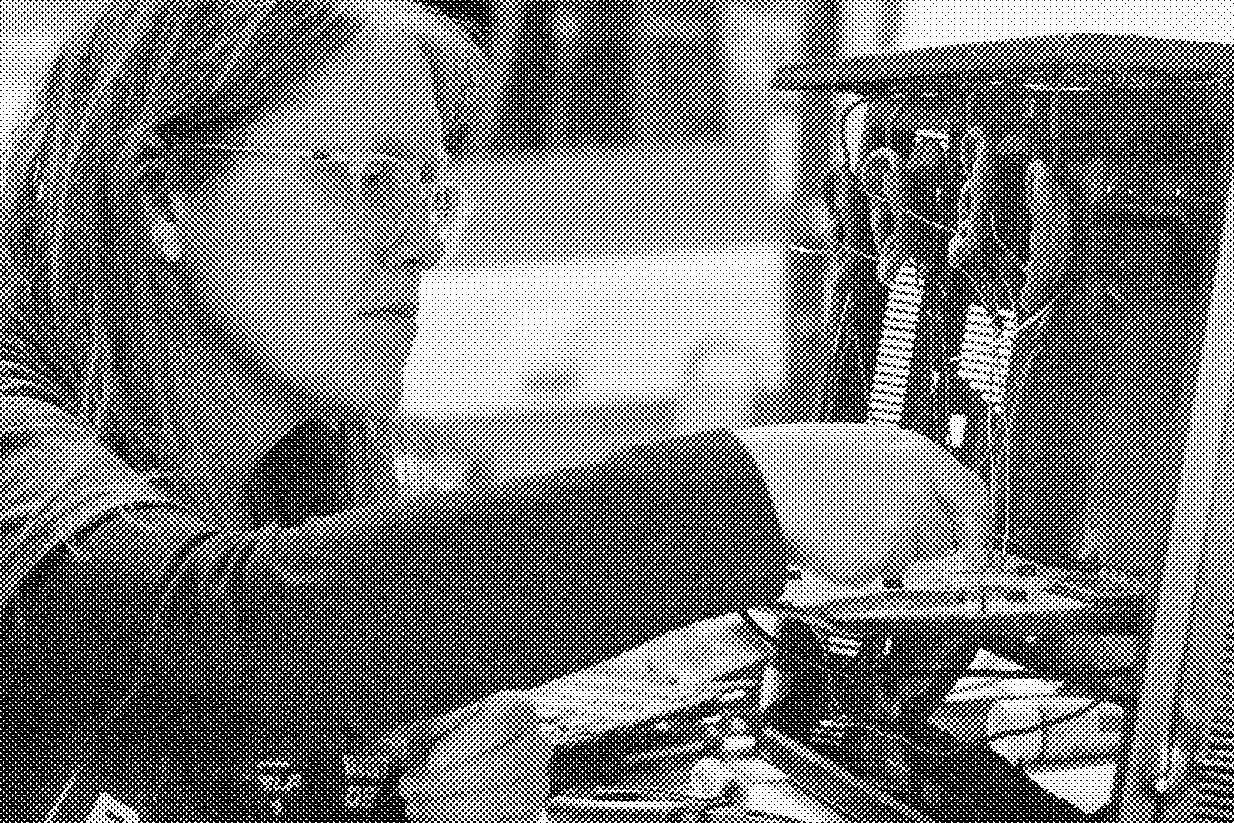
    Magnetic Light Score The starting point of the project is the exploration of analog video technologies as instruments for sound and imagery. At its core is a VCR, which is understood not merely as a storage medium but as an electromechanical resonating body. Its circuits, magnetic heads, and signal paths form a system in which image, light, and sound continuously interlock. A live camera generates a continuous video signal that is immediately routed through the VCR and displayed on a CRT monitor. At the same time, light pulses from the video signal are translated into acoustic events. Changes in brightness, contrast, and timing are transformed into frequencies, pulses, and continuous sound structures. The audiovisual system evolves as Magnetic Light Score: The project begins with an exploration of analog video technologies as instruments for sound and imagery. At the center is a VCR, which is understood not merely as a storage medium but as an electromechanical resonating body. Its circuits, magnetic heads, and signal paths form a system in which image, light, and sound continuously interlock. A live camera generates a continuous video signal that is immediately routed through the VCR and displayed on a CRT monitor. At the same time, light pulses from the video signal are translated into acoustic events. Changes in brightness, contrast, and time are transformed into frequencies, pulses, and continuous sound structures. The audiovisual system thus evolves into a closed feedback architecture in which image production and sound production influence one another. The project conceives of translation not as a lossless transfer of information, but as a material process. Every transition between light, electrical signals, magnetization, and sound alters the properties of the source material. The apparatus does not produce a representation, but rather a sequence of physical transformations whose aesthetic quality arises directly from the characteristics of the technologies employed. The light listens when the VCR becomes an instrument. Not an archive, but a breathing resonator. A camera gazes into the room and records the present moment as magnetic traces. This creates a score. The light composes itself. In the end, there is no recorded image and no finished composition. What remains is a cycle—a continuous interplay between light and sound, between surface and depth, between what becomes visible and what has always been audible.
  • Kollektiv eigenklang

    Kollektiv eigenklang

    The eigenklang collective was founded in 2017 within Kassel’s subculture scene, when the founding members came together during documenta fourteen to explore the possibilities of organic live looping and participatory music. From these beginnings, the eigenklang installation and a shared mission emerged: to create interactive happenings in which the audience not only consumes art and culture but also actively participates in their creation. The collective is composed of a delicious blend of multidisciplinary artistic ingredients and is refined and seasoned by fellow artists depending on the location and context. In addition to the eigenklang installation, the artists work with visual installations, inclusive art and media education, and professional (360°) audio and video productions. They specialize in inclusive community arts projects, have many years of experience working with people with disabilities, and create multimedia productions that are accessible to all participants. Interaction and improvisation are essential elements of their artistic practice. Over the past eight years, the eigenklang collective has organized more than 300 eigenklang happenings with thousands of people in a wide variety of contexts and countries—from clubs, festivals, and galleries to housing projects, street intersections, riverboats, and rainforest clearings—while developing both the technical installation and the interactive continuously evolving interactive performance. The eigenklang collective operates in the fields of community arts and community music, moving semi-nomadically between touring and communal living. The collective lives and creates in rural Brandenburg, works at Schloss Bröllin—an international arts production venue—and travels between Leipzig and Berlin, regularly participating as guests in various projects and communities. This way of life reflects their commitment to authentic community work and ensures that every eigenklang event is shaped by its specific cultural and social context.

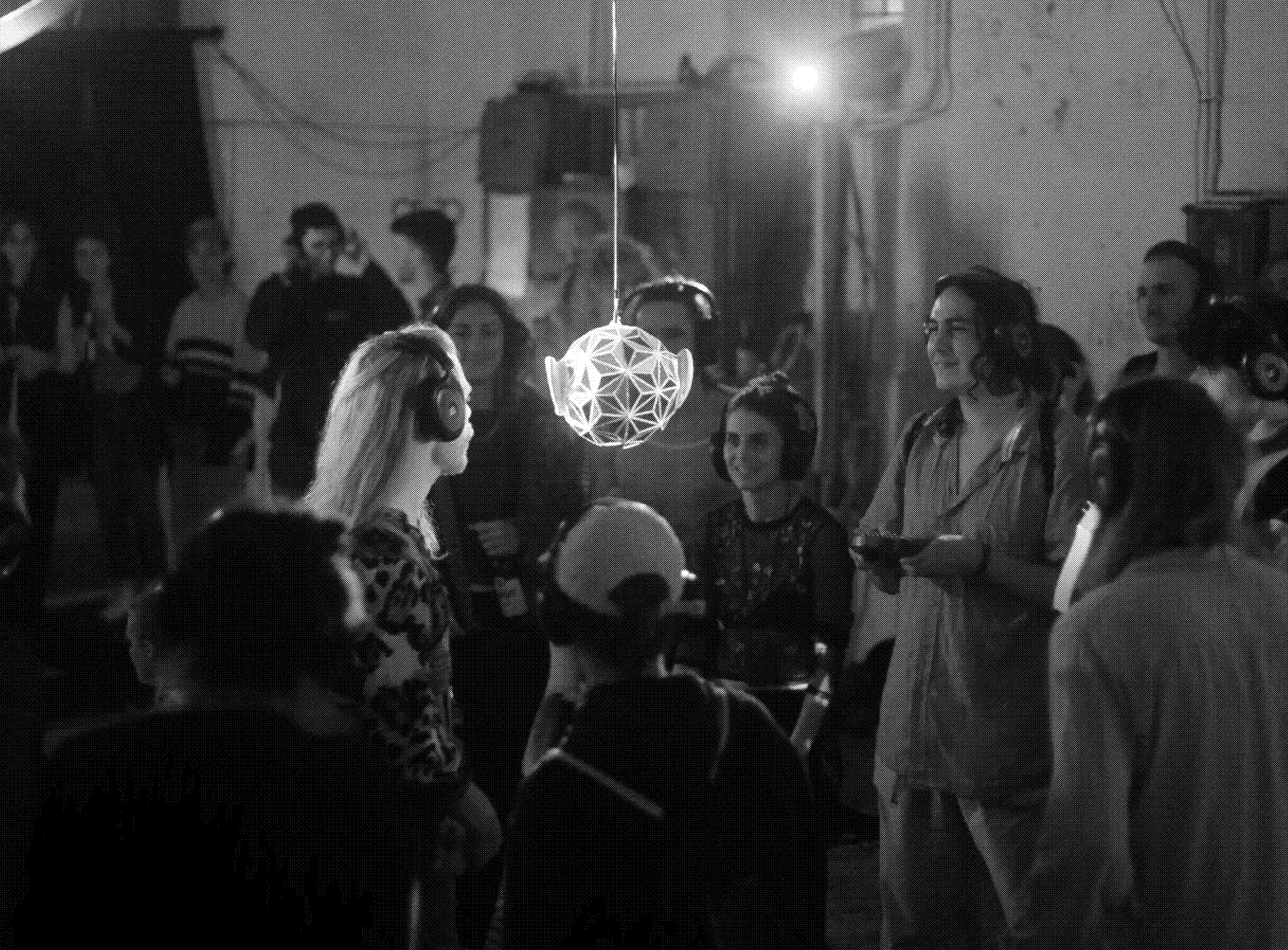
    eigenklang is an interactive audiovisual experience that is difficult to describe. Due to changing settings, a wide variety of participants, and the collective’s thirst for exploration, every experience is different: a sound playground, musical team-building, a deeply personal sound therapy session, or a collective audio journey. The technical process remains the same: All participants are connected via wireless headphones to a binaural microphone at the center of the installation—a human disco ball that hears everything happening around it. Using loops, effects, samples, and synthesizers, fascinating soundscapes emerge that invite participants to immerse themselves. Participants can simply listen and enjoy, or contribute with their own voice, breath, movements, or any other sound—as musicians, visual artists, dancers, or in whatever form of expression emerges. eigenklang experiments with new forms of interactive musical happenings and blurs the traditional boundaries between listeners and artists, music and chance, reality and perception Every event is an exercise in equality and nonverbal communication through sound—because music has always been the language everyone understands. These playful spaces transform the audience from passive listeners into playful musicians and—hopefully—into a fantastic orchestra of sounds. Rooted in Kassel’s subculture, where the collective came together during documenta fourteen (2017), eigenklang returns home with the RANGE Festival: an interactive audiovisual installation featuring wireless headphones, open to collective exploration—an experimental playground for the senses, an invitation to the playful soul, and, for some, even therapy. We invite you on a sonic journey to places you’ve never experienced before.

  • Samuel Goldbourne / djfroggy69

    Samuel Goldbourne / djfroggy69

     I like to create a feeling of fullness, thats why I often choose to layer a lot. That can look like a track that functions as the base notion of the mix layered with another track that takes up the role of the mids and another track that I position in the highs. And then from time to to time I add vocals. I like to move from spherical, associative, non figurative to direct narration. Multichannel installations feel like the logical follow up of mixing as a dj. Mixing but thought in a spacial context where depending on how you position your body you get to hear a different version of the piece. Piecing Art together where every part is a sample, a piece of a collage. Positioning speakers, positioning samples, positioning visitors. Sound as a phenomenon you can position yourself to. My expericence as an experience you can position yourself to. Samples I use as narrations I position and distort, dislocate, relocate – you can position yourself to. Sound machines make you feel more intensely, along a broader band of emotional spectra than ever before in the 20th Century. Sonically speaking, the posthuman era is not one of disembodiment but the exact reverse: it’s a hyperembodiment, via the Technics SL 1200. (P00(-002), Kodwo Eshun, More Brilliant Than the Sun: Adventures in Sonic Fiction, 1998)

    Phenomenology and Object and Sound Placement in Space Collage and Sampling as a Contextualization Practice Contextualization and Phenomenology My queer body in context creolite creolisation christian Sound and phenomenology set design I don’t believe in hell or heaven. I believe in love and in community in being right in doing wrong and in trying out. I believe that white supremacy erases inbetweens. I believe in change and I believe in hope. I believe that you can change how you move your focus, how your gaze is directed, how you adjust your actions. I believe that a lot has changed the moment I put love in my gaze towards my body and my queerness. I believe in the uses of anger and the power of the erotic (Audre Lorde). I believe in my friends and family to be crucial factors in change. I believe that fear is a destructive power. I actually believe in kindness and honesty. I believe in decolonizing your mind. I believe that you won´t find love in neither capitalism nor white supremacy. I believe that destroying white eurocentric/western supremacy starts in our direct communal structures. Werkangaben: Papa, can you hear me? , 2026, 8-Channel Sound-installation ,30 min ,Puppe, 4 different Zines in 4 vdifferent color ways , FIMO flowers Samples by Johann Sebastian Bach, Minnie Ripperton, Eraserhead Heaterlady, Motherlode, Sunday Service Choir, Yulola, Muva earth, Halloween sounds 

  • Sven Berg aka monoyama

    Sven Berg aka monoyama

    Sven Berg is a German sound artist who works under the name monoyama. In his artistic practice, he explores sound as a state rather than a medium. Through reduction, autonomous systems, and spatial installations, he investigates how perception shifts when sound is understood as structure, behavior, and material. At the center of his practice is the Mobile Laser Projection Machine (MLPM), which he developed himself—a system that translates frequencies into precise light geometries through mechanical transduction. Digital data, electromagnetic signals, white noise, and recorded objects serve as material for works in which sound becomes perceptible beyond the realm of hearing. Rather than producing narratives, these autonomous systems reveal their own internal logic. Sound, light, and space function as interconnected states, making hidden relationships visible through minimal intervention and precise technological processes. His installations and performances create conditions in which sound, light, and space become perceptible as a single system.

    MLPM – Kinetic Spatial Installation conceives of sound not as a fleeting medium, but as an unyielding, site-specific state. The work radically dissolves the boundary between auditory transience and sculptural presence. Through three independently developed machines, analog audio signals are directly translated into razor-sharp lines of light via mechanical transduction. Similar to the physical friction of a vinyl needle in a record groove, the devices work with real physical matter rather than digital perfection to force frequencies into precise geometric patterns of light and make sound perceptible beyond the realm of hearing. At the heart of the work lies the shift in human perception between seeing, hearing, and feeling. In the total darkness of the room, the eye takes the lead: viewers perceive sound as structure even before the ear decodes the signal. At the same time, the signal travels directly into the body as a deep, somatic vibration. The audience does not consume narratives but becomes part of a synesthetic system in which the eye literally anticipates the physical vibration of the space. Through an infinite program loop, the three machines operate completely autonomously and reveal their own internal logic. The relentless lines of light cut through the structure and fragment the viewers’ lines of sight. The result is a minimal intervention characterized by maximum technological precision, which allows sound, light, and space to be experienced as a single, cohesive system.

  • Allen Homburg, Sidney Mantei, Samuel Julian Grace

    “Twenty to Two Thousand” explores the experience of sound beyond auditory perception. The project utilizes the technological properties of subwoofers and low-frequency drivers to generate low-frequency sounds in a controlled environment. At an appropriate volume, low-frequency sounds can be felt by the body as well as heard by the ear, thereby creating an intense multisensory experience. The immediate effect of bass and sub-bass on the body, as well as the body’s relationship to architectural space, are the focus of this collaborative work by Allen Homburg, Samuel Julian Grace, and Sidney Mantei. Each artist has contributed an extended composition designed specifically for playback in a frequency range between 20 Hz and 2,000 Hz.

    One subwoofer, 125 × 40 cm; two woofers, 120 × 30 cm

    2026

    Duration: Loop

    Sidney Mantei

    Sidney Mantei is a sound and media artist who has been studying at the Kassel Art Academy since 2022. In addition to the visual arts, the 29-year-old artist from Heidelberg works on more musical formats. Through an intense engagement with 1980s pop music, Sidney Mantei develops a contemporary reflection that utilizes the distortion of formats and ensemble configurations as an integral artistic means.

    Allen Homburg

    Allen Homburg is a sound artist and musician based in Kassel. His artistic practice consists of performative formats, compositions, and research into sound production. As an artist of Armenian descent, his major musical influences include electronic dance music and the folk music of the Ashughs.

    Samuel Julian Grace

    Samuel Julian Grace is an Irish–Salvadoran artist based in Germany who works primarily with sound. His practice explores how people experience and make sense of artworks, and how perception, attention, and understanding unfold over time. Rather than producing fixed objects, Samuel creates active works that change through interaction, inviting viewers, listeners, and the environment to participate.