Tag: 2026

  • ct dug + owen sake

    ct dug + owen sake

    Owen will be performing for you. ct will be joining him to make sure it’s an unforgettable experience for you and your friends (if you’d like).

    This time, we’d like to offer you an experience in which various instruments are mixed and modulated using synthesis and effects. It’s a sort of pre-programmed concert that could take different turns as it unfolds.

  • shasti

    shasti

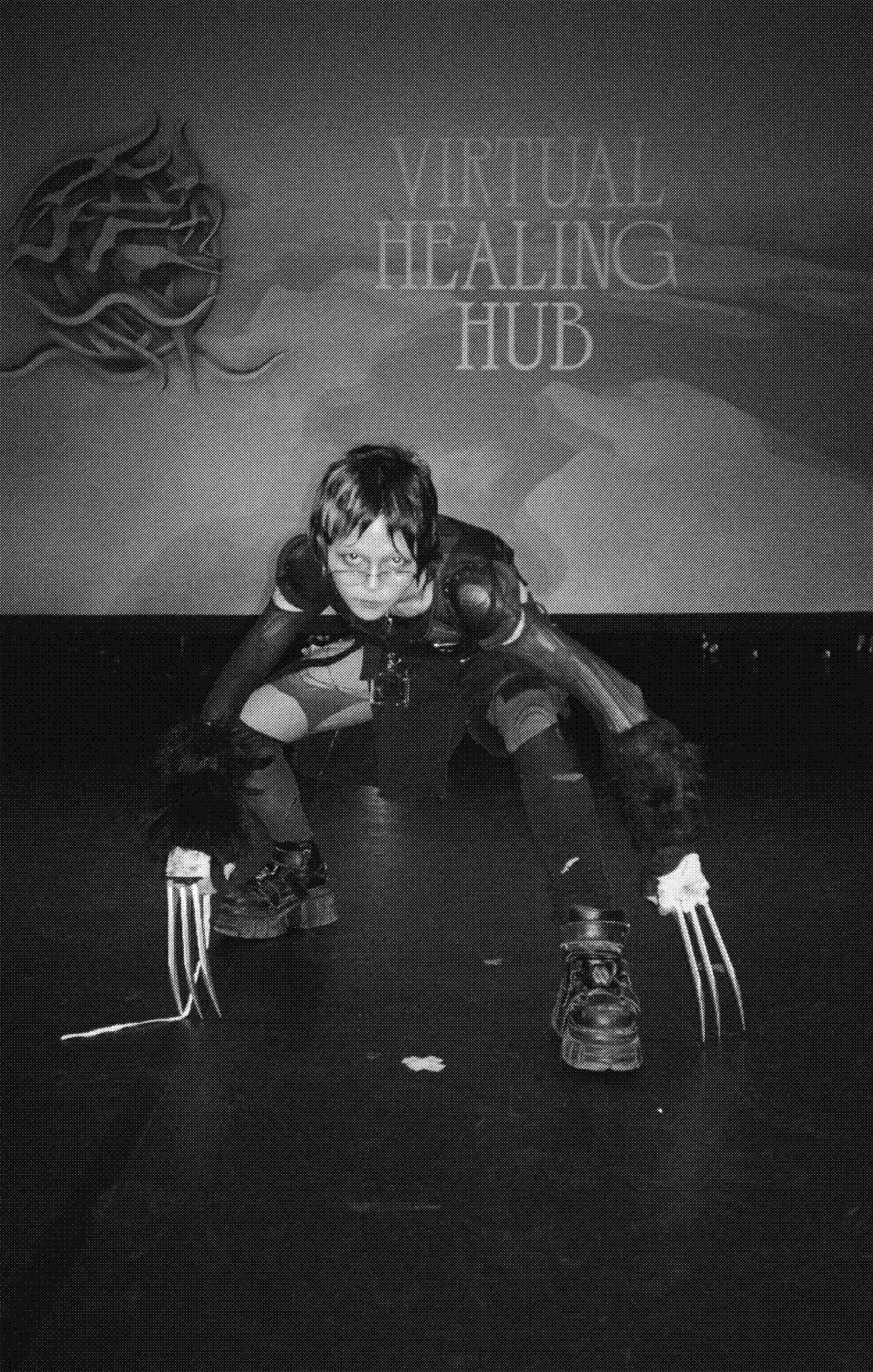
    shasti (they/them/dia) is an artist, organizer, and DJ born in Jakarta who lives between Berlin and Bochum. Shasti’s work in the field of digital art encompasses performance, live audiovisual sets, and multimedia productions such as sound and mixed realities. Shasti’s works create a form of hauntology in which the relationship between magic, technology, the body, and community represents a political re-enchantment. In collaboration with 3D artist songxin, they created a world shaped by memories and the revolutionary vision of ghost stories. Dia’s work “Phantom Power” combines digital voice modification with the performative embodiment of the monstrous and has been featured in several productions, including “Virtual Healing Hub” by dgtl fmnsm and “Unreal Conditionals” by Janne Kummer and g.h0st.damXg. Shasti currently works at the Kunstmuseum Bochum as a staff member for digital and hybrid art education.

    An audiovisual set that combines DJing and VJing. The DJ set itself is geared more toward storytelling. I explore the themes of dreams, fantasy, and isekai—the idea of being transported into a game world. Rather than portraying this as an escape from reality, I offer a perspective of re-enchantment.

  • Brian Liu and Franziska Ullrich

    Brian Liu and Franziska Ullrich

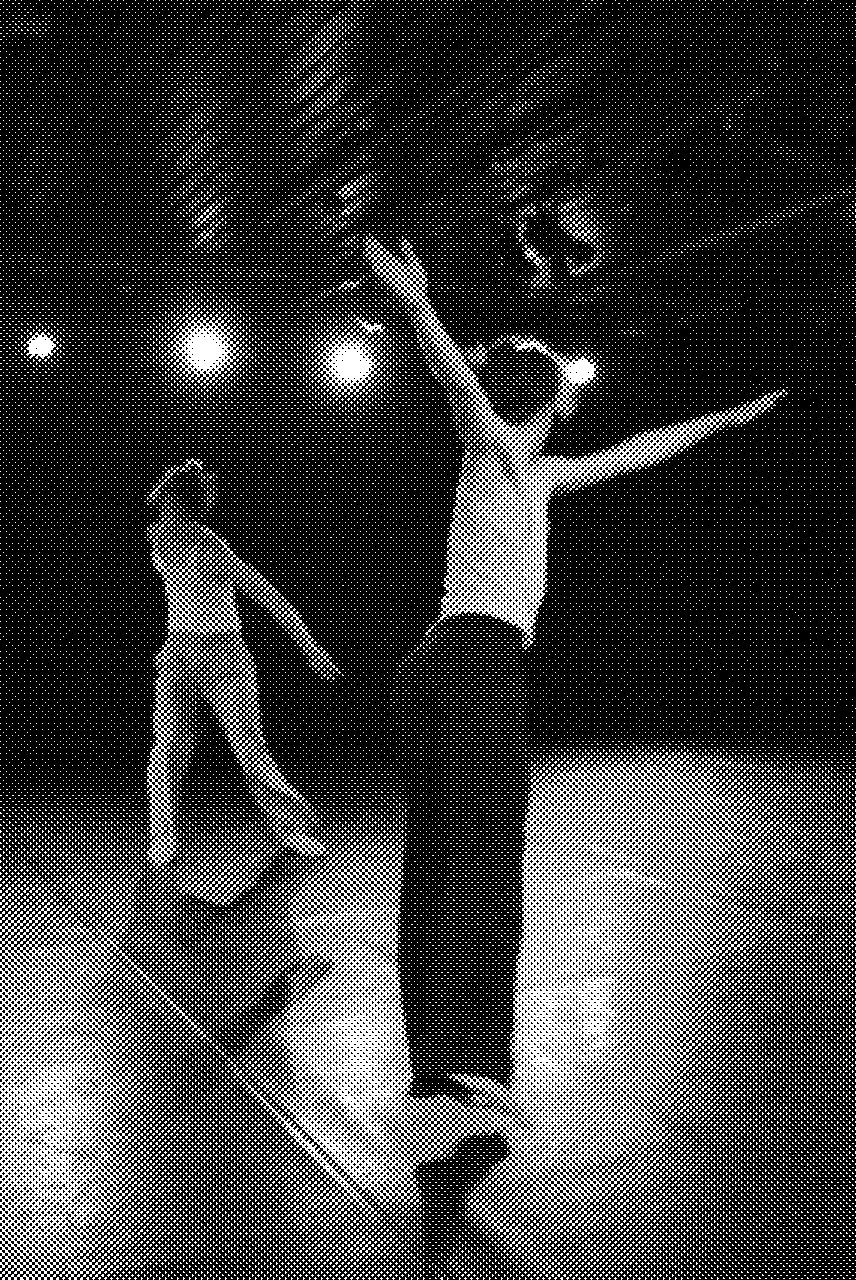
    Brian and Franziska both completed their training as contemporary stage dancers at Sozo Visions in Motion in Kassel. Both bring with them experience from many years of musical practice, studies in the visual arts, and skills in urban and acrobatic dance as well as physical theater. In 2025, they began their collaborative movement research and regularly present improvised duets at open stages or exhibitions.

    What was distant becomes intimately close. What lies at the core, we reveal to the outside world. Equipped with microphones and pickups, skin and hair become the resonating bodies of the dance performance.

  • Mitsitron

    Mitsitron

    Mitsitron is a sound artist, musician, and program curator. She explores collective ways of making one’s voice heard—both as a personal and a political process. By employing queer methods in sound and performance, she seeks to break through binary thinking and move toward multifaceted experiments. This gives rise to moments that create space for listening and shared reflection. In their solo sets, they manipulate their guitar and vocals live using creative coding. They are active in Rotterdam’s experimental and improvised music scene and perform at venues such as Worm, Roodkapje, Varia, Time is the New Space, and iii in The Hague. They have performed twice at the Art Meets Radical Openness Festival in Linz, in 2024 and 2026. They have spoken about their work at Panteion University in Athens, at Radio Operator in Rotterdam, at Creative Coding Utrecht, and at the REMIX Festival in Hilversum. They are part of the “Platform for Extratonality,” where they organize workshops and performance evenings centered on non-dominant sound production. They are a member of the Varia collective, which explores cultural work in contrast to Big Tech. In 2026, they will serve as program curators for MaMA Rotterdam and curate an exhibition on grief from social and political perspectives. They have a background in architecture, jazz guitar, and experimental publishing.


    Lament for the weird is a performance for mourning in public. A space for processing the destruction caused by normativity. This lament is Mitsitron’s effort to reconnect with sonic traditions of their roots that they first understood as vulgar through their flat modernised schooling. Their music lovingly glitches “greekness” which as every national formation excludes queers and ethinically others. The lament for the weird is everchanging: it is as a collage of a live processed electric guitar, expanded vocals, the Plug Data visual coding system and greek modes that touch the heart of those exiled from them.

  • Jan Grebenstein

    Jan Grebenstein

    Jan Grebenstein is a producer, DJ, and artist from Kassel. After years as a drummer and guitarist in various bands, he made his solo debut in 2014 with a four-track EP on Downwards Records, the label run by Regis (Karl O’Connor)—a label that has stood for uncompromising techno and industrial aesthetics since the 1990s. Under the name Grebenstein, he developed a minimalist, physical sound that blends techno, industrial, and experimental electronic music. This was followed by releases on the experimental labels Horo—including the EP “Gloss” (2017)—and Osiris Music UK, which further refined his signature style: sparse, economical production and tension created through omission. In 2021, a second alias, GEZA, followed: The debut “Dialoge” on Avian emerged as a reaction to a love-hate relationship with techno—produced under self-imposed restrictions: a maximum of five minutes of recording time, no more than four tracks per piece, and a synthesizer with an 8-step sequencer. The use of limitation as a method runs through both projects as a defining approach. Grebenstein has performed live and as a DJ on major stages of the experimental club music scene: at the CTM Festival in Berlin, at the Säule in Berghain, and at Tresor Berlin—most recently in 2024 at “Tresor meets Downwards” alongside Regis and Ancient Methods—as well as at the Lunchmeat Festival in Prague, at KHIDI in Tbilisi, and at the Electro-Mechanica Festival in St. Petersburg. In addition to his work in music, Grebenstein works as a designer at the creative agency Dorfmeyster, developing visual identities and communication concepts for, among other things, cultural and foundation projects. He does not view sound and image as separate disciplines, but rather as two forms of expression within the same practice.

    The performance combines my live set with sound-reactive visuals, which also form the basis of the Range Festival’s visual identity. The audience thus does not experience an illustration of music—they witness the festival’s identity taking shape. The concept stems from the intersection of my two practices, and in this performance, both roles converge: The festival’s visual system is not pre-programmed but is controlled in real time by sound—the frequencies, dynamics, and rhythm of the music directly influence the form, movement, and density of the graphics. Musically, the set ranges from minimalist techno to industrial and experimental electronic music—following the aesthetic of my previous releases: sparse, physical, and economical. This minimalism is reflected in the visuals: no decorative embellishments, but rather a strict system that comes to life under the influence of sound.

  • Felicity Mangan

    Felicity Mangan

    Felicity Mangan is an Australian sound artist and composer based in Berlin. In her sound works, she combines field recordings, synthesis, and electroacoustic composition techniques to create quasi-bioacoustic music. Her works have been presented in multichannel installations, live performances, site-specific contexts, and on various music albums.

    A live performance featuring electroacoustic sounds, in which field recordings and FM synthesis are combined to create quasi-bioacoustic music.

    felicitymangan.org

  • Maerie C. Fricke

    Maerie C. Fricke

    Maerie C. Fricke works with sound, materiality, and process-based sculptural installations. Drawing on her research, she develops intermedia works that explore material traces, technical infrastructures, and forms of transmission. She is currently exploring a partisan understanding of resistance through the appropriation of knowledge and investigating the history and materiality of radios as sites of communication, contact, and political agency. After spending an Erasmus year studying site-specific art at the University of Applied Arts Vienna, she transferred from the Kassel Art Academy to the Düsseldorf Art Academy to join Nina Canell’s class.

    per ardua ad astra (870 kHz) A message full of questions to the universe is broadcast via a homemade AM transmitter and received by analog radios. Enveloped in dust, interference, and electromagnetic noise, the signal is reflected in the Earth’s expanding radio bubble as a drifting archive, in which the broadcasts continue to resonate long after their voices have already faded away.

  • Clemens Pitschke

    Clemens Pitschke

    Clemens Pitschke is an acoustician and field recordist. He is a co-founder of the multidisciplinary sound exploration project “Land.Schafft. Sound,” within which he organizes and leads workshops and has invited experts from various fields—including nature conservation, science, and music—who engage intensively with sound in their work. He is also a board member of GERÄUSCHKULISSE e.V. in Leipzig, an association that places a clear focus on listening and has been providing a platform for formats such as radio features, sound art, and performances for over 10 years. In recent years, Clemens has engaged intensively with the topics of bioacoustics and soundscape ecology and, through field recordings, has both contributed to citizen science projects and produced creative works for outlets such as Deutschlandfunk. His work focuses on knowledge transfer and actively engaging with our acoustic environment through soundwalks, workshops, and field recording sessions.

    For this year’s Range, I’d like to offer a combination of a soundwalk and a bird-song tour. We’ll begin by exploring hearing and the perception of sound as it relates to humans and the animal world. We’ll start with two short listening exercises to sharpen our sense of hearing, and then explore a location in Kassel on a 1–2-hour soundwalk. Unlike a traditional soundwalk—which focuses exclusively on listening to and experiencing the acoustic environment and typically involves no talking—we’ll occasionally discuss what we’re hearing in the moment. This quickly makes it clear, on the one hand, how individual each person’s perception is and, on the other hand, how difficult it can sometimes be to describe sound in words in a way that makes it tangible for everyone and allows us to find a shared language of sound. In October, most birds become less active. Some migrate away, stop by as guests on their journey, or arrive for the winter months. It is precisely this slightly lower level of activity that helps us focus on specific species and thus find a way to explore bird songs and shared listening.

    www.clemenspitschke.de

  • Olaf Val

    Olaf Val

    Olaf Val (born in Hanau in 1968) studied art in Kassel and completed his graduate studies at the Academy of Media Arts in Cologne. He has exhibited regularly since 1996—including internationally until 2014—and has worked as a freelance artist since 2003 and taught as a lecturer since 2004. From 2012 to 2022, he was an active board member of the Kassel Art Association, for which he curated solo and group exhibitions, among other activities. Since then, his artistic focus has shifted toward ecological issues, which he increasingly explores through the medium of sound art—with the aim of making a poetic appreciation of the environment tangible through sound.

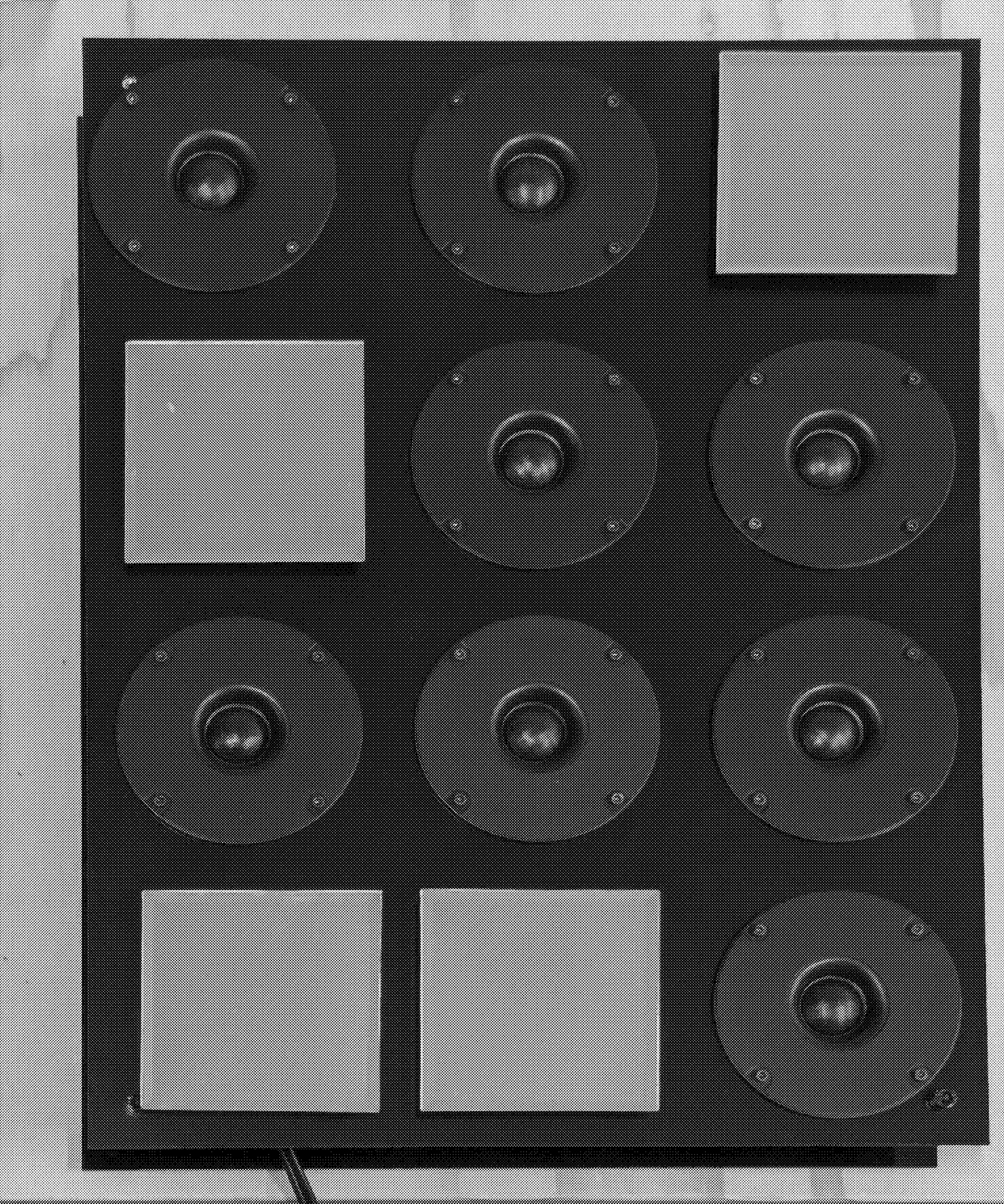
    THRESH()LD At a time when social and ecological systems are under increasing pressure, the multichannel sound object THRESH()LD develops an acoustic language for experiencing structural fragility. The installation explores those critical thresholds where materials, bodies, and social structures are on the verge of collapse—a state that can be described as a “global risk society.” Unlike many large-scale sound installations, THRESH()LD concentrates its energy within a compact, sculptural form. The work unfolds not through expansion but through condensation: its small size deliberately invites the viewer to approach it. Only those who approach it experience the subtle vibrations, reflections, and sonic processes. Thus, the sculpture functions less like a speaker system and more like an artistic-technical entity in which physical processes and subjective perception converge. THRESH()LD transforms contemplative art appreciation into a collective test of endurance. The dissonant sound frequencies challenge visitors’ physical and psychological tolerance thresholds and make their own thresholds immediately palpable. In this way, THRESH()LD positions itself as a critical intervention in a time of multiple crises: it makes audible and tangible what often remains abstract. The installation thus becomes an instrument that registers the shifts in our present and transforms them into an intense sensory experience in action. 12-channel audio object Plugdata sketch with a generative composition 1 Raspberry Pi 5 2 ESI Gigaport eX audio interfaces 6 ZHITING 200W TPA3116 amplifiers 8 VISATON SC 10N tweeters 4 LAVOCE bass drivers with attached mirrors

  • Anja Kellner and Hakon Hennig

    Anja Kellner and Hakon Hennig

    Anja Kellner is a multifaceted artist whose interactive installations, kinetic works, and media art reflect on sociopolitical themes such as sustainability, gender equality, and the impact of the digital revolution on everyday life. The “Deja-Vú Tabula Rasa” series of works illustrates her ability to combine artistic visions with technological and social innovations. In installations such as “Auge um Auge” or “Forced Swing,” she uses sound to convey fragments of memory and resonant catastrophes. In developing “LiSe—the light sensor,” which opens up new possibilities for accessibility for the blind, she demonstrates her creative and technical expertise. With artistic sensitivity, she addresses environmental issues in the design of alternative “dye-sensitized solar cells.” Her artistic research feeds into projects such as “Power Plant,” a multimedia installation that generates CO₂-negative energy via microbial fuel cells. The perpetual motion machine serves as a positive, utopian narrative for overcoming the climate crisis. Her experience informs a visiting lectureship during the 2024–25 winter semester on the topics of the “Internet of Things” and “Sound Worlds” at the Kassel Art Academy. Likewise, her long-standing work with Hakon Hennig—an electronics developer and artist with a background in electrical engineering and photography—has complemented this perspective with his technical expertise. His contribution an Tarek Atoui’s project “Metastable Circuit 1” (documenta 13), as well as art installations such as “Gespräch unter vier Augen,” “Erraquisition,” and “ComfortClock,” demonstrate his ability to integrate technical systems into artistic contexts. Transparency and the revelation of technical components and circuitry characterize his artistic practice. Through the development of a vacuum chamber for electron diffraction and the design of an innovative circuit for his Polarskop, Hakon impressively demonstrates his profound and comprehensive understanding of complex systems. This complexity becomes aesthetically tangible in his kinetic works.

    Magnetic Light Score The starting point of the project is the exploration of analog video technologies as instruments for sound and imagery. At its core is a VCR, which is understood not merely as a storage medium but as an electromechanical resonating body. Its circuits, magnetic heads, and signal paths form a system in which image, light, and sound continuously interlock. A live camera generates a continuous video signal that is immediately routed through the VCR and displayed on a CRT monitor. At the same time, light pulses from the video signal are translated into acoustic events. Changes in brightness, contrast, and timing are transformed into frequencies, pulses, and continuous sound structures. The audiovisual system evolves as Magnetic Light Score: The project begins with an exploration of analog video technologies as instruments for sound and imagery. At the center is a VCR, which is understood not merely as a storage medium but as an electromechanical resonating body. Its circuits, magnetic heads, and signal paths form a system in which image, light, and sound continuously interlock. A live camera generates a continuous video signal that is immediately routed through the VCR and displayed on a CRT monitor. At the same time, light pulses from the video signal are translated into acoustic events. Changes in brightness, contrast, and time are transformed into frequencies, pulses, and continuous sound structures. The audiovisual system thus evolves into a closed feedback architecture in which image production and sound production influence one another. The project conceives of translation not as a lossless transfer of information, but as a material process. Every transition between light, electrical signals, magnetization, and sound alters the properties of the source material. The apparatus does not produce a representation, but rather a sequence of physical transformations whose aesthetic quality arises directly from the characteristics of the technologies employed. The light listens when the VCR becomes an instrument. Not an archive, but a breathing resonator. A camera gazes into the room and records the present moment as magnetic traces. This creates a score. The light composes itself. In the end, there is no recorded image and no finished composition. What remains is a cycle—a continuous interplay between light and sound, between surface and depth, between what becomes visible and what has always been audible.
  • Kollektiv eigenklang

    Kollektiv eigenklang

    The eigenklang collective was founded in 2017 within Kassel’s subculture scene, when the founding members came together during documenta fourteen to explore the possibilities of organic live looping and participatory music. From these beginnings, the eigenklang installation and a shared mission emerged: to create interactive happenings in which the audience not only consumes art and culture but also actively participates in their creation. The collective is composed of a delicious blend of multidisciplinary artistic ingredients and is refined and seasoned by fellow artists depending on the location and context. In addition to the eigenklang installation, the artists work with visual installations, inclusive art and media education, and professional (360°) audio and video productions. They specialize in inclusive community arts projects, have many years of experience working with people with disabilities, and create multimedia productions that are accessible to all participants. Interaction and improvisation are essential elements of their artistic practice. Over the past eight years, the eigenklang collective has organized more than 300 eigenklang happenings with thousands of people in a wide variety of contexts and countries—from clubs, festivals, and galleries to housing projects, street intersections, riverboats, and rainforest clearings—while developing both the technical installation and the interactive continuously evolving interactive performance. The eigenklang collective operates in the fields of community arts and community music, moving semi-nomadically between touring and communal living. The collective lives and creates in rural Brandenburg, works at Schloss Bröllin—an international arts production venue—and travels between Leipzig and Berlin, regularly participating as guests in various projects and communities. This way of life reflects their commitment to authentic community work and ensures that every eigenklang event is shaped by its specific cultural and social context.

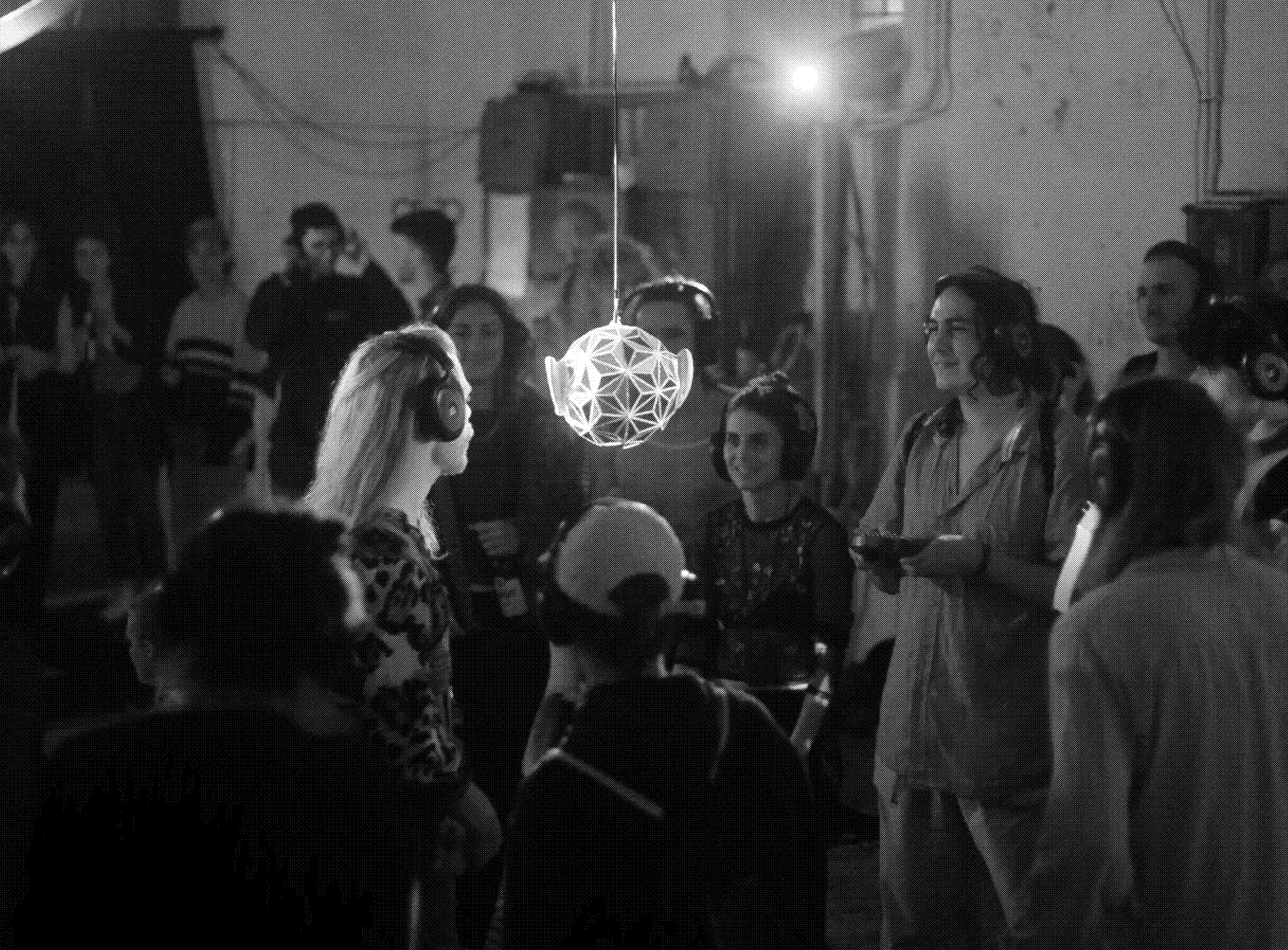
    eigenklang is an interactive audiovisual experience that is difficult to describe. Due to changing settings, a wide variety of participants, and the collective’s thirst for exploration, every experience is different: a sound playground, musical team-building, a deeply personal sound therapy session, or a collective audio journey. The technical process remains the same: All participants are connected via wireless headphones to a binaural microphone at the center of the installation—a human disco ball that hears everything happening around it. Using loops, effects, samples, and synthesizers, fascinating soundscapes emerge that invite participants to immerse themselves. Participants can simply listen and enjoy, or contribute with their own voice, breath, movements, or any other sound—as musicians, visual artists, dancers, or in whatever form of expression emerges. eigenklang experiments with new forms of interactive musical happenings and blurs the traditional boundaries between listeners and artists, music and chance, reality and perception Every event is an exercise in equality and nonverbal communication through sound—because music has always been the language everyone understands. These playful spaces transform the audience from passive listeners into playful musicians and—hopefully—into a fantastic orchestra of sounds. Rooted in Kassel’s subculture, where the collective came together during documenta fourteen (2017), eigenklang returns home with the RANGE Festival: an interactive audiovisual installation featuring wireless headphones, open to collective exploration—an experimental playground for the senses, an invitation to the playful soul, and, for some, even therapy. We invite you on a sonic journey to places you’ve never experienced before.

  • Samuel Goldbourne / djfroggy69

    Samuel Goldbourne / djfroggy69

     I like to create a feeling of fullness, thats why I often choose to layer a lot. That can look like a track that functions as the base notion of the mix layered with another track that takes up the role of the mids and another track that I position in the highs. And then from time to to time I add vocals. I like to move from spherical, associative, non figurative to direct narration. Multichannel installations feel like the logical follow up of mixing as a dj. Mixing but thought in a spacial context where depending on how you position your body you get to hear a different version of the piece. Piecing Art together where every part is a sample, a piece of a collage. Positioning speakers, positioning samples, positioning visitors. Sound as a phenomenon you can position yourself to. My expericence as an experience you can position yourself to. Samples I use as narrations I position and distort, dislocate, relocate – you can position yourself to. Sound machines make you feel more intensely, along a broader band of emotional spectra than ever before in the 20th Century. Sonically speaking, the posthuman era is not one of disembodiment but the exact reverse: it’s a hyperembodiment, via the Technics SL 1200. (P00(-002), Kodwo Eshun, More Brilliant Than the Sun: Adventures in Sonic Fiction, 1998)

    Phenomenology and Object and Sound Placement in Space Collage and Sampling as a Contextualization Practice Contextualization and Phenomenology My queer body in context creolite creolisation christian Sound and phenomenology set design I don’t believe in hell or heaven. I believe in love and in community in being right in doing wrong and in trying out. I believe that white supremacy erases inbetweens. I believe in change and I believe in hope. I believe that you can change how you move your focus, how your gaze is directed, how you adjust your actions. I believe that a lot has changed the moment I put love in my gaze towards my body and my queerness. I believe in the uses of anger and the power of the erotic (Audre Lorde). I believe in my friends and family to be crucial factors in change. I believe that fear is a destructive power. I actually believe in kindness and honesty. I believe in decolonizing your mind. I believe that you won´t find love in neither capitalism nor white supremacy. I believe that destroying white eurocentric/western supremacy starts in our direct communal structures. Werkangaben: Papa, can you hear me? , 2026, 8-Channel Sound-installation ,30 min ,Puppe, 4 different Zines in 4 vdifferent color ways , FIMO flowers Samples by Johann Sebastian Bach, Minnie Ripperton, Eraserhead Heaterlady, Motherlode, Sunday Service Choir, Yulola, Muva earth, Halloween sounds 

  • Sven Berg aka monoyama

    Sven Berg aka monoyama

    Sven Berg is a German sound artist who works under the name monoyama. In his artistic practice, he explores sound as a state rather than a medium. Through reduction, autonomous systems, and spatial installations, he investigates how perception shifts when sound is understood as structure, behavior, and material. At the center of his practice is the Mobile Laser Projection Machine (MLPM), which he developed himself—a system that translates frequencies into precise light geometries through mechanical transduction. Digital data, electromagnetic signals, white noise, and recorded objects serve as material for works in which sound becomes perceptible beyond the realm of hearing. Rather than producing narratives, these autonomous systems reveal their own internal logic. Sound, light, and space function as interconnected states, making hidden relationships visible through minimal intervention and precise technological processes. His installations and performances create conditions in which sound, light, and space become perceptible as a single system.

    MLPM – Kinetic Spatial Installation conceives of sound not as a fleeting medium, but as an unyielding, site-specific state. The work radically dissolves the boundary between auditory transience and sculptural presence. Through three independently developed machines, analog audio signals are directly translated into razor-sharp lines of light via mechanical transduction. Similar to the physical friction of a vinyl needle in a record groove, the devices work with real physical matter rather than digital perfection to force frequencies into precise geometric patterns of light and make sound perceptible beyond the realm of hearing. At the heart of the work lies the shift in human perception between seeing, hearing, and feeling. In the total darkness of the room, the eye takes the lead: viewers perceive sound as structure even before the ear decodes the signal. At the same time, the signal travels directly into the body as a deep, somatic vibration. The audience does not consume narratives but becomes part of a synesthetic system in which the eye literally anticipates the physical vibration of the space. Through an infinite program loop, the three machines operate completely autonomously and reveal their own internal logic. The relentless lines of light cut through the structure and fragment the viewers’ lines of sight. The result is a minimal intervention characterized by maximum technological precision, which allows sound, light, and space to be experienced as a single, cohesive system.

  • Allen Homburg, Sidney Mantei, Samuel Julian Grace

    “Twenty to Two Thousand” explores the experience of sound beyond auditory perception. The project utilizes the technological properties of subwoofers and low-frequency drivers to generate low-frequency sounds in a controlled environment. At an appropriate volume, low-frequency sounds can be felt by the body as well as heard by the ear, thereby creating an intense multisensory experience. The immediate effect of bass and sub-bass on the body, as well as the body’s relationship to architectural space, are the focus of this collaborative work by Allen Homburg, Samuel Julian Grace, and Sidney Mantei. Each artist has contributed an extended composition designed specifically for playback in a frequency range between 20 Hz and 2,000 Hz.

    One subwoofer, 125 × 40 cm; two woofers, 120 × 30 cm

    2026

    Duration: Loop

    Sidney Mantei

    Sidney Mantei is a sound and media artist who has been studying at the Kassel Art Academy since 2022. In addition to the visual arts, the 29-year-old artist from Heidelberg works on more musical formats. Through an intense engagement with 1980s pop music, Sidney Mantei develops a contemporary reflection that utilizes the distortion of formats and ensemble configurations as an integral artistic means.

    Allen Homburg

    Allen Homburg is a sound artist and musician based in Kassel. His artistic practice consists of performative formats, compositions, and research into sound production. As an artist of Armenian descent, his major musical influences include electronic dance music and the folk music of the Ashughs.

    Samuel Julian Grace

    Samuel Julian Grace is an Irish–Salvadoran artist based in Germany who works primarily with sound. His practice explores how people experience and make sense of artworks, and how perception, attention, and understanding unfold over time. Rather than producing fixed objects, Samuel creates active works that change through interaction, inviting viewers, listeners, and the environment to participate.

  • KAINA

    KAINA

    Soukaina El Adak is a visual artist currently completing a Bachelor’s degree at the Kunsthochschule Kassel, Germany. Her artistic practice explores questions of identity, migration, and cultural memory, with a particular focus on postcolonial and diasporic experiences. Working across painting, installation, and performance, she examines how identity is shaped through language, representation, and collective narratives. Her work often draws from personal experience while engaging with broader social and political contexts. Through her practice, El Adak seeks to create spaces for reflection, dialogue, and the questioning of fixed cultural categories.

    This set builds on my last range set and delves even deeper into traditional Moroccan music. I want to explore the languages, instruments, and stories behind the songs.

  • Spiders

    Spiders

    Spiders (they/them) is an electronics and game engineer as well as a little messy sfx angel. They build synthesizers, do drag, produce electronic sound works and internationally perform on stage since 2019.

    The Dolls Speak (working title): A history of trans-feminine vocals in electronic music. From the vocoder to voice training cassettes to pitch shifting and vocaloids. Formatted as a performance lecture.

  • Eeva Ojanperä

    Eeva Ojanperä

    is a media artist and filmmaker based in Kassel. She creates multimedia and interactive installations that bridge indoor and outdoor spaces, the past and the present, and nature and technology. Her multisensory works explore identity, loss, connection, and transformation—shaped by her history spanning Finland, Russia, and Germany. As a filmmaker and sound designer, she contributes to film and TV productions, curates festivals such as the Range Sound Festival, and is dedicated to educational outreach on topics related to sound, the environment, and nature.

    ROOMTONE examines silence as a condensed social state. The starting point is a practice from filmmaking: the recording of “roomtones”—one minute of apparent silence from each filming location, which remains invisible in post-production but conveys atmosphere. Transposed into public and semi-public spaces, these recordings capture places of waiting and thresholds: government offices, hallways, waiting rooms, and transition zones. These spaces are not empty—they are charged with tension, time pressure, and anticipation. Here, silence becomes a resonating chamber for collective states of mind. The fragments are mixed, layered, and set to a rhythm—a composition of unremarkable moments in which time seems to stretch. ROOMTONE makes audible what is otherwise muted: the tension in stillness, the political dimension of waiting, and the question of who silence belongs to—and upon whom it is imposed.

  • NØ-1 Lou Lévêque

    NØ-1 Lou Lévêque

    is a composer and sound researcher based in Brussel. In their practice, Lou moves between composition and experimentation, blending baroque, electronic and punk influences, combining writing, improvisation and raw energy. Lou grounds their music in a political and social reflection, seeking spaces of freedom where art becomes a means of resistance and transformation.

    Crumple Nest is born from chaos – from madness clawing at the edges of reason, where thinking becomes impossible, where one sinks; depression haunting so many trans lives, a shared fog – the raw pain of sex perverted by trauma, STDs as brutal reminders of bodily betrayal, and the suffocating weight of rape culture. Conceived from the bed’s cave, this crumpled nest as improvised refuge, the album is a balm crafted to survive together: everything nests there, transformed into enveloping, healing textures. These aren’t abstract horrors; it’s the raw flesh of my anarcho-communist, feminist, whore, and trans life fighting in a world that devours the vulnerable. The album forges a sonic refuge: breaths in anxiety attacks glitching into powerful noise, enveloping sounds recentering chaos into an impregnable fortress. Politically, it’s a cry against capitalism and its exploiters – those polluting our air, overexploiting workers, crushing bodies. Live shows channel this rage through noise, mimicking human biological rebellion fighting to survive. Crumple Nest distills this energy into glitching wheezes bursting into cathartic release, confronting systemic madness. Trans and militant project, it reclaims sound as collective weapon and intimate balm. Tracks crumple and unfold like anxious lungs: dense textures against isolation’s crush, airy expanses for fleeting safety. It’s music for crisis, fuck, fever – intimate electronics politicizing the personal. In a culture stifling screams, Crumple Nest amplifies them into collective embrace.

  • Tobias Böhm

    Tobias Böhm

    is a film sound engineer and sound designer from Kassel. For many years, he has been working at the intersection of film, documentary, art, and sound research. His work centers on the question of how sound tells stories, makes spaces tangible, and shapes our perception of reality. As a film sound engineer, he has been involved in numerous documentary and feature film productions, including the theatrical releases Xoftex, Rave On, and Servus Papa – See You in Hell. His work encompasses recording original sound on set as well as the creative development of acoustic concepts for film productions. From 2009 to 2019, Böhm was a research assistant at the Kassel Art Academy. There, he supported projects in the fields of film and media art and led workshops on film sound production and field recording. In addition to his work in film, he explores sound documentation, acoustic perception, and the cultural significance of hearing. In doing so, he combines technical precision with an interest in social, historical, and ecological issues. Böhm is committed to professional exchange within the film sound industry and is a member of the German Film Sound Association (bvft). In addition, he develops and supports projects that foster dialogue between filmmakers, the arts, academia, and the general public. His work views sound not merely as a technical element, but as an independent means of observation, creation, and communication.

    Diegetic Music Production in Feature Films—Between Reality and Dramaturgy Music in film can be much more than just emotional background accompaniment. It becomes particularly compelling when it becomes part of the narrative world: as a band on stage, as radio playing in the background, or as a musical event within a scene. This so-called diegetic music presents film sound teams with unique creative and technical challenges. Sound editors Eeva Ojanperä and Tobias Böhm (bvft) discuss their experiences on feature film productions where they were jointly responsible for the original sound. Using concrete examples, they provide insights into the planning, recording, and post-production of diegetic music on the film set. How do they manage to combine musical authenticity with cinematic storytelling? When is music played live, and when is playback used? What demands does this place on direction, cinematography, acting, and sound? And how can dialogue, sound effects, and music be recorded in a way that meets both the dramatic and technical requirements of a feature film production? In their discussion, Ojanperä and Böhm explain the key production steps—from preparation through filming to the final mix—and demonstrate the narrative possibilities that diegetic music opens up. In doing so, they highlight just how strongly musical decisions can influence the perception of characters, spaces, and stories.The event is intended to kick off a new series of talks at the Range Sound Festival. The next installment is planned for next year and will focus on bioacoustics, field recording, and sound in installations. The event is aimed at filmmakers, those interested in sound, students, and all festival guests who would like to gain insight into the creative and technical aspects of professional sound work.

  • Cat Woywod

    Cat Woywod

    Cat Woywod challenges habitual ways of perception through intermedia art. Site-specific interventions, performing arts, and electroacoustic sound art are woven together using minimal technical means to create complex experiences of space and time. Born in post-reunification Germany as the descendant of artisans, she grew up in Silicon Valley, USA; among the lignite mines of the Lower Rhine; in the limestone, slate, and metal industries of the Bergisches Land; and on the farmlands of the Upper Bavarian Pre-Alps. Cat Woywod has lived and worked in Kassel since 2016.

    For RANGE 2026, Cat presents “KRAK,” a multisensory radio composition and publication that challenges quantifying notions of perception, the body, and environments.

    “KRAK” was created as part of Cat’s master’s thesis in “Sound Art/Composition” at the Mainz University of Music in 2026.

    https://catwoywod.bandcamp.com/track/krak-live-radio-show

    Cat is active in Kassel as a freelance artist, electroacoustic composer, event technician and coordinator, and as a drag thing performer.

  • Saguaro

    Saguaro

    Saguaro (born in Cologne) lives in Kassel and works as a freelance artist in the fields of drawing, music, and film. His work reflects an interest in visual, written, and acoustic languages—as evidenced by his degree in English literature and philosophy—and how their abstraction shapes our reality.

    A typewriter, a guitar. The former is connected to a looper pedal via a contact microphone; as the keys are typed, a rhythm emerges. Then the second instrument comes into play, exploring the typed rhythms through improvisation.

  • Diego Asens

    Diego Asens

    Alongside finishing my studies at the Kunsthochschule of Kassel, I have been developing over the last few months a digital platform focused on sound art and music, with a radio station, an archive, collections and didactic tools. We launched it in April of this year as an evolution of the Chair Radio project, a series of radio programs broadcasted live from our studio and through Trafo Radio over several months of 2025. There I was primarily involved on the technical and curatorial side, building collaborations with artists from within and outside the city and putting together programs with a wide variety of voices and formats. My work can be understood on different levels, but I have a particular interest in reaching people and creating spaces where the people who make up my day to day life feel invited and can engage. I refuse to see art as something elitist. As a result, what I produce tends to be stripped of the superfluous and reduced to its essence, from which it can evolve. Following this conceptual line I began quite young to get involved in the hip hop scene of northern Madrid. Painting graffiti and rapping, which later led me to the techno scene as a DJ, and I started organizing events and illegal raves that continue to this day. In recent years, following these currents, I have moved into the world of sound as a rawer and more experimental way. Making sound installations, performances at events like Vera Sonora or radio programs like Trafo Listening Sessions, working with my body, with field recordings, analogue and digital instruments, old tapes and flamenco vinyl records. In the Rundgang of 2024 we created Sobremesa, a community project where through the collective act of cooking and sitting down to eat together we built a space for exchange, gathering and rest, that year bringing together more than 40 people, groups and collectives. Since then it has been developed twice with students from the Hegelsbergschule, and it took part in Gallerie Fest 2025 with the association Ag Südstadt at the space MOOIMOOI.

    read more↗

  • Thea Josepha Konatsu

    Thea Josepha Konatsu

    Thea Josepha Konatsu is an artist, educator, and musician. Her intermedia practice explores dislocation and the influence of cultural conditioning on our understanding of history and memory. Memories, fragments, and snippets are brought together in malleable montages and woven into stories, moving images, and sound. Her artistic practice explores the conflict-ridden diversity of different cultures and the associated self-positioning and localization in a globalized world. Thea studied art education, English and American Studies, and visual communication at the Kassel Art Academy, the University of Kassel, and the Taipei University of the Arts. In 2022–23, she received the Huayu Enrichment Scholarship from the Taiwanese Ministry of Education, the HAB Graduation Scholarship, and a grant from the DAAD, through which she produced her graduation film “speaking nearby: Shaking Skies & Trembling Earth” (2024) in Taiwan. In 2024, she was a master’s student under Prof. Joel Baumann in the New Media Research Area at KHK. Her works have been shown in exhibitions and festivals in Taiwan, Indonesia, Nigeria, the Netherlands, and Germany. In 2025, she received the Kassel Art Prize from the City of Kassel.

    “When I’m here, I cannot be there” is a vocal exploration of the state of being in-between. If here, then not there. If there, then not here. How can these opposites be united? Or come together in their difference?